

ON AUGUST 1, 1889, the California legislature passed a bill authorizing a portion of rural agricultural Los Angeles County to form a new county named “Orange.” As the agricultural landscape shifted from grape growing and hog farming to citrus groves, the political landscape also shifted. During the first half of the 20th century, the Ku Klux Klan built a stronghold in the county, most notably in Anaheim. By the mid-1920s, racist and antisemitic sentiments increased with propaganda, and Klansmen were comprised of prominent members of the community. Klansmen often used the respect of their powerful positions to influence others to join their local Ku Klux Klan units, called Klaverns. In the 1930s, racial segregation and discrimination became visible in daily life activities including schools, public swimming pools, theaters, and restaurants. Multiracial tensions continued to heighten on the precipice of impending war to uphold racial hierarchies.

Hand colored map on 4 sheets. Finley, S. H. and H.S. Crocker & Co. San Francisco, 1889. Courtesy of Library of Congress Geography and Map Division Washington.
Map of Orange County, 1889
Orange County officially seceded from Los Angeles County on August 1, 1889. By World War II, the following Orange County cities had been incorporated: Brea, Fullerton, Huntington Beach, La Habra, Laguna Beach, Newport Beach, Placentia, San Clemente, Seal Beach, and Tustin.
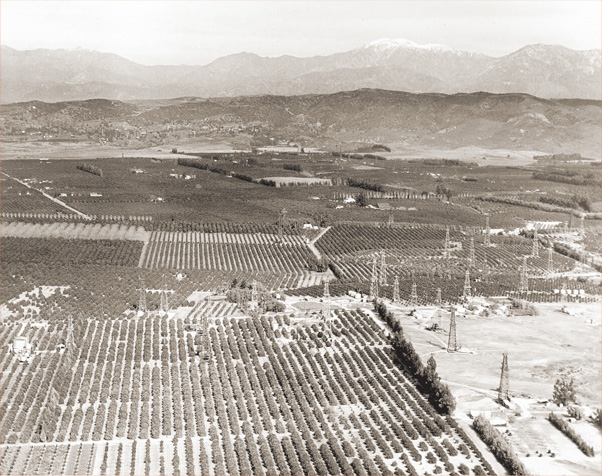
Huntington Beach, California, c. 1920. California Historical Society Collection, 1860–1960. Courtesy of the USC Libraries Special Collections.
Aerial View of Orange Groves and Oil Fields North of Huntington Beach, c. 1920
Orange County remained largely rural during the first half of the 20th century, with its economy rooted in agriculture, particularly citrus crops. The Hewes Ranch, for example, was located in the Foothill District of Orange County. Its crops included oranges, lemons, and avocados. This aerial view of Huntington Beach shows views of orange groves and oil fields.
IN THE 1920S, GROUPS SUCH AS THE KU KLUX KLAN (KKK) gained a foothold in Orange County cities, particularly in Anaheim. The Klan targeted not just Blacks, but also Jews, Catholics, and foreigners. They found a sympathetic audience as the United States shifted from a rural agricultural society to an urban industrial society.
In Anaheim, members of the Klan were elected to political office in 1924, and the Klan became more overt in announcing its presence and power in the city: “The Invisible Empire’s increasingly overt involvement in the community was dramatically demonstrated at a mammoth open air rally and initiation ceremony at Anaheim City Park on July 29, 1924.”
Anaheim was promoted as a model Klan city. Ten thousand Klansmen from across Southern California attended the initiation ceremony for 1,000 new Klansmen at Anaheim City Park on July 29, 1924. Anaheimers, in reaction to this display, worked to destroy the Klan, leading to its political downfall in 1925.
Christopher N. Cocoltchos. “The Ku Klux Klan in Anaheim, California,” in The Invisible Empire in the West: Toward a New Historical Appraisal of the Ku Klux Klan of the 1920s, edited by Shawn Lay. Urbana: University of Illinois Press, 1992.

Courtesy of the Anaheim Public Library.
Ku Klux Klan Members in Automobile Advertising Lecture At Anaheim Christian Tabernacle, c. 1924–1925
Lectures hosted by the Ku Klux Klan were open to the public and anyone could attend. The intent was to encourage people to join the Anaheim Klavern.
THOUGH OVERT KLAN ACTIVITIES WERE LESS PREVALENT in Orange County than in other parts of the country, displays of power and racist statements were common.
Allan Fainbarg, a founder of the Jewish Community Foundation of Orange County who grew up in Orange County, remembers seeing a Klansman in 1929.
“I remember one time around 1929, there was a Ku Klux Klansman on horseback that came to downtown Santa Ana, right down Fourth Street, and I remember the chief of police went and grabbed the leader of the Ku Klux Klan and unveiled him and it was a prominent businessman in town here. I do not want to mention his name, but I recall it very vividly. Another example of antisemitism was a fellow named Williams who put out newsletters and pamphlets and was very well-known during the late 40s and 50s.”
In “An Interview with Allan Fainbarg,” Jewish Pioneers of Orange County: The Jewish Community of Orange County, California from the 1850s–1970s, edited by Dalia Taft. Western States Jewish History, 2012.
Constance Farlice Duffy, who was born in Santa Ana in 1922 and whose father was the first African American to purchase a home in Santa Ana, comments on a general awareness of the Klan.
“Your dad was aware of the Klan because the Klan was very strong in the mid-1920s. Did he talk to you about the Klan?
Nothing. I just knew that it was something that hated us. The only people I might have known would be the fathers of some of my classmates, and naturally they’re not going to say anything to me. So I never knew anybody that was a member. My dad knew the members and knew who they were.”
In “Growing Up in a Small Black Community,” A Different Shade of Orange: Voices of Orange County, California, Black Pioneers, edited by Robert A. Johnson and Charlene Riggins. Fullerton: California State University, 2009.