

WORLD WAR II TRANSFORMED THE RURAL FARMLAND area of Orange County with the development of three military installations: the Naval Air Station Santa Ana, which housed the lighter-than-air airships to patrol the Pacific Ocean coastline; the Santa Ana Army Air Base, which served as a cadet training center; and the Marine Corps Air Station El Toro, which was designated a Master Jet Station in 1950.
In the weeks following the Japanese attack on Pearl Harbor, the United States was on high alert along both the East and West coasts. Defending the West coast was a Navy fleet of nonrigid lighter-than-air airships that patrolled the coastline 24 hours a day. The airships were capable of hovering and staying airborne for long periods of time, making them ideal for spotting enemy submarines along the US coastline. The hangars built to house the large airships in the Naval Air Station Santa Ana were a major engineering achievement of World War II, impressive for both their timber structure and their speedy construction. The hangars built at the Naval Air Station Santa Ana are just two of seven hangars that remain as evidence of the defense of the home front.
A LIGHTER-THAN-AIR AIRSHIP is Navy terminology for a blimp. The nonrigid airships used during the war did not have an internal structural framework. Instead, the airship maintained its shape from the pressure of the helium used to lift it. Costing about $300,000 ($5.6 million in 2021 dollars) each, the K-Class blimps of World War II carried a crew of eight, could reach speeds of more than 76 miles per hour and cover over 2,000 miles in a single flight. The United States airship fleet was used for scouting, convoy escorts, antisubmarine patrols, and search and rescue missions throughout World War II.
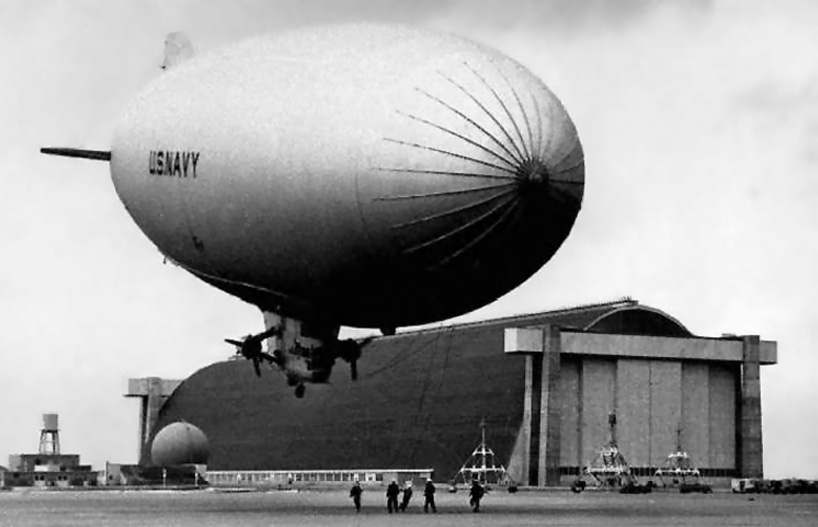
Tustin, California. Official US Navy photo.
US Navy Blimp in Front of One of the Massive Airship Hangars at the Naval Air Station Santa Ana (Later MCAS Tustin), 1943
By the end of 1942, there were 12 K-Class blimps operating from Tustin as Airship Patrol Squadron ZP-31, for Zeppelin Patrol 31. Airship patrols along the California coast were conducted 24 hours a day from the airship bases in Santa Ana and Moffett Field in the bay area.
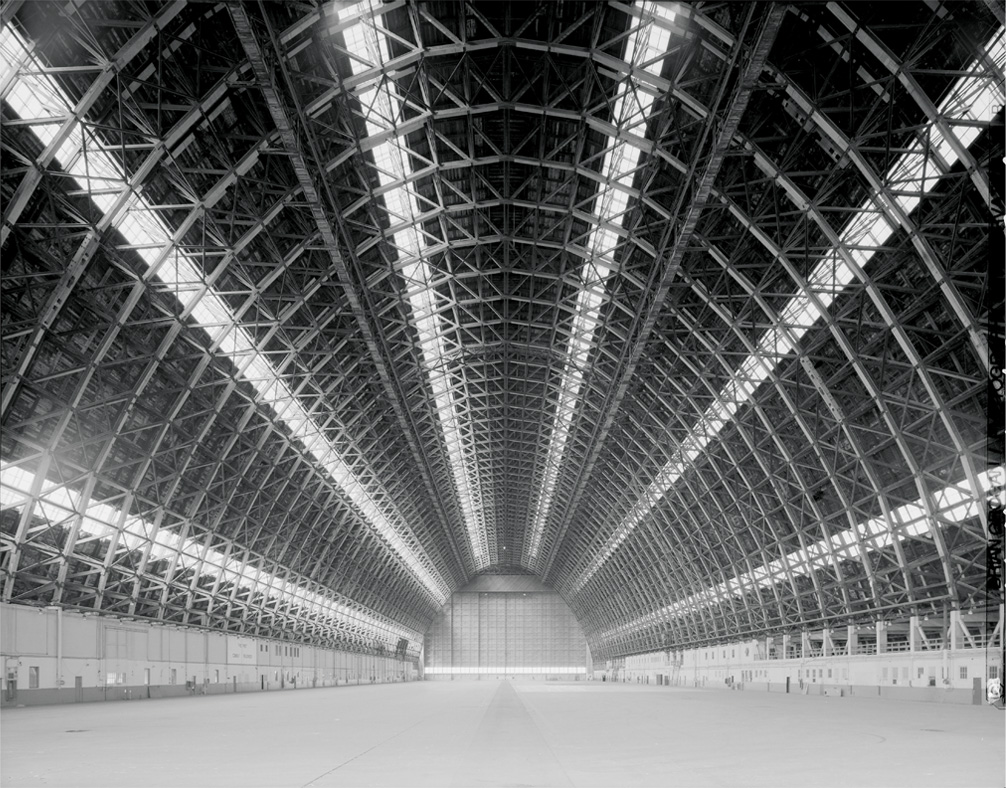
Tustin, California. June 30, 1949. Photography by Brian Grogan. Historic American Buildings Survey Collection, Library of Congress Prints and Photographs Division. (The citation lists “Meffett,” but the name of the street is actually “Moffett.”)
Blimp Hangar at the Former Naval Air Station Marine Corps Air Station Tustin, Northern Lighter-Than-Air Ship Hangar, Meffett (Sic) Avenue & Maxfield Street, 1949
Each hangar measured 1,088 feet in length and 297 feet in width, with timber arches set on 20-foot centers. The hangars were 178 feet or over 17 stories tall. The all-wood design was a direct result of the realities of war. Although 33 tons of structural steel was used in building the hangars, traditional construction would have required over 4,000 tons of steel.

Drawing no. 212817. Tustin, California. Historic American Buildings Survey, Library of Congress Prints and Photographs Division.
Lighter-Than-Air Hangar Roof Truss Details, c. 1942
The airship hangars remain among the largest wood-framed structures in the world. This image depicts the intricate work to build the hangars.
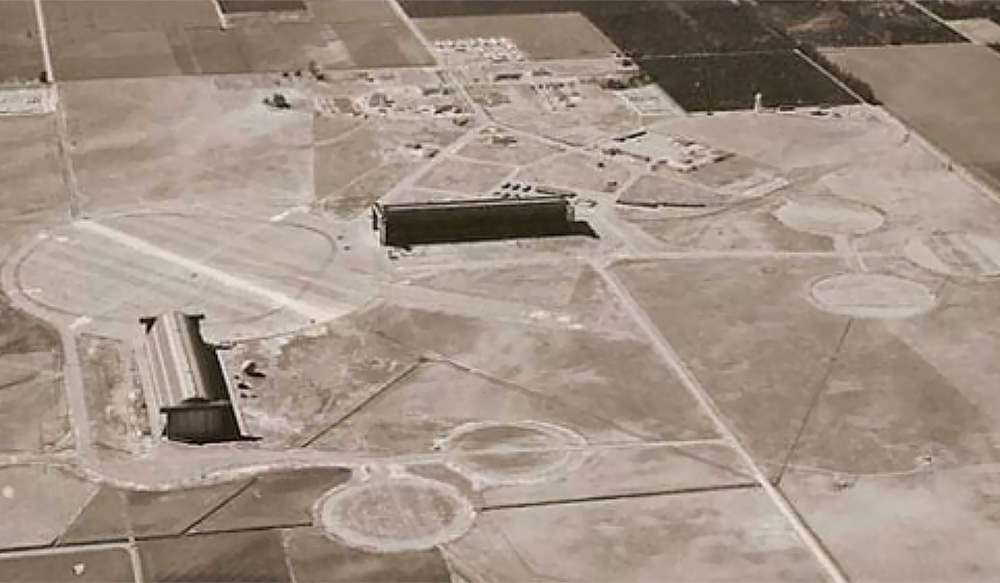
Tustin, California. Library of Congress.
Marine Corps Air Station Tustin, East of Red Hill Avenue Between Edinger Avenue & Barranca Parkway, c. 1945.
An aerial view shows the Naval Air Station Santa Ana base as having the two 1,058 x 297 foot blimp hangars. The two hangars were separated by a large circular landing mat that was about 2,000 feet in diameter, with six smaller landing mats placed around the hangars in a cloverleaf pattern.
“IN 1928, CHIEF OF NAVAL AVIATION REAR ADMIRAL W.A. MOFFETT ARRIVED AT EDDIE MARTIN AIRFIELD, NOW JOHN WAYNE AIRPORT, to meet with James Irvine II, owner of the vast Irvine Ranch, to discuss the Tustin and the Canada del Toro (sic) sites.”
“James Irvine was reluctant to sell either site. Both were productive and profitable as farm fields for the Irvine Ranch itself, or as lease land for other farming interests. Irvine was especially reluctant to sell the Tustin site, which had a very high water table that made it ideal for farming. Locals jokingly called the area that would become the Tustin base “La Cienega de Las Ranas” — “The Frog Swamp” — because the ground water was so high that the soil was almost always moist. Ironically, the same high water table would become a major challenge for any future construction on the site, including the hangars. Fortunately for Irvine, Moffett chose an alternate location in Northern California. But thirteen years later, just after the attack on Pearl Harbor, the War Department returned to Orange County to find a site, this time, with even more determination.
They reopened negotiations with James Irvine for what would become the Tustin base, some 1,600 acres of farm fields that seemed ideal for a Lighter-Than-Air (LTA) facility, along with the larger site at Canyon del Toro, some 15 miles to the south, which would serve for fixed-wing aircraft.”
The Tustin Hangars: Titans of History. An historical account of the MCAS Tustin Hangars. RBF Consulting. July 2008.

Tustin Area Historical Society. Courtesy of the Orange County Public Library.
James Irvine II, c. 1920
LISTED ON THE NATIONAL REGISTER OF HISTORICAL PLACES and designated a National Historical Civil Engineering Landmark, the two hangars remain among the largest free standing wooden structures in the world. The hangars have been featured in prominent television shows and films, including JAG (Episode 18, 1st Season), The X Files (Episode 12, 6th season), Austin Powers (1997), Pearl Harbor (2001), and Star Trek (2009). They were also featured in several major car commercials.
[POSTEXHIBIT NOTE: One of the two renaming Tustin blimp hangers (North #1) was destroyed in a fire in November 2023.]