

IN THE MID-19TH CENTURY, JAPANESE IMMIGRANTS BEGAN TO ARRIVE in the United States, starting families, founding businesses and farms, and becoming citizens. However, the American dream for these first-generation Japanese Americans crumbled following the Japanese attack on Pearl Harbor in Honolulu, Hawaii on December 7, 1941. The surprise military air strike by the Japanese Navy resulted in the United States’ formal entry into World War II. On February 19, 1942, President Franklin D. Roosevelt signed Executive Order 9066 that authorized the removal of all persons deemed a threat to national security from the West Coast to relocation centers further inland. As a result, 120,000 people of Japanese ancestry, most of whom lived on the Pacific Coast, were forcibly relocated and incarcerated in camps in the western interior of the country. Approximately two-thirds of the internees were United States citizens. These artifacts show how local Japanese citizens and immigrants lived through this dark period of American history.
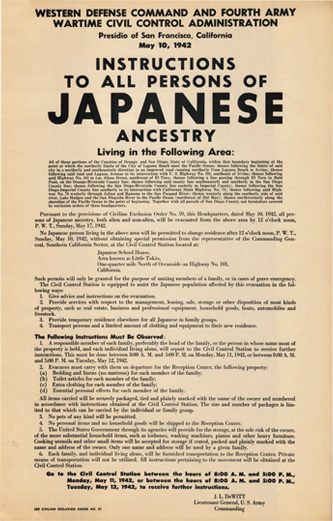
Western Defense Command and Fourth Army Wartime Civil Control Administration. May 23, 1942. Courtesy of Hoover Institution Library and Archives Poster Collection.
Enforcement of Order 9066
In February of 1942, President Franklin Roosevelt signed Order 9066, legalizing the removal of individuals of Japanese ancestry from the West Coast of the United States to 10 “relocation centers” run by the War Relocation Authority (WRA). This document is a set of instructions for those living in Orange County and San Diego County.

Arcadia, California. Official OWI Photo. International Mission Photography Archive, Circa 1860-1960. Courtesy of University of Southern California Digital Library.
Santa Anita Park Assembly Center Vaccinations, July 1942
Before being relocated, Japanese Americans were vaccinated against smallpox and typhoid fever at temporary assembly centers like the one in Arcadia, California. Under the direction of Dr. Norman Kobayashi, Japanese American nurses vaccinated approximately 400 people an hour in Santa Anita Park. Evacuees were later transferred to War Relocation Authority Centers, or internment camps, for the duration of the war.
ALTHOUGH LIFE IN THE WAR RELOCATION AUTHORITY CAMP BARRACKS was small, cramped, and surrounded by barbed wire, Japanese Americans worked hard to improve their surroundings through the establishment of schools, gardens, and other recreational activities.
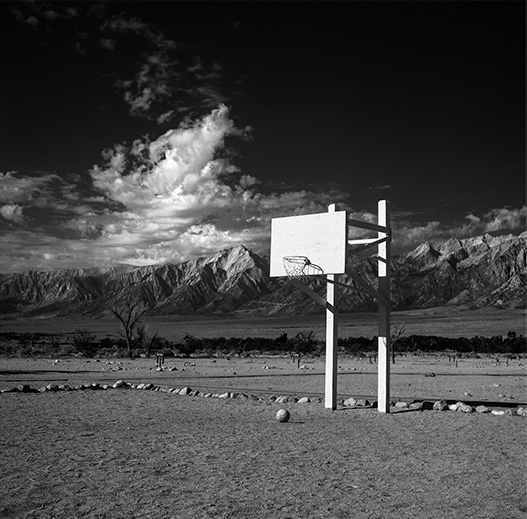
2021. Image credit: Allan Helmick.
Basketball Court at the Japanese Relocation Camp in Manzanar, California.

Official OWI Photo. International Mission Photography Archive, c. 1860–1960. Courtesy of University of Southern California Digital Library.
Women Playing Baseball at Japanese Relocation Camp in Manzanar, California, July 1942
This photo was taken of women playing a baseball game on the grounds of Manzanar Internment Camp, located at the foot of the Sierra Nevada mountains in California, shortly after they were imprisoned in 1942.