

ORANGE COUNTY, CALIFORNIA WAS BUILT ON, AND CONTINUES TO BE KNOWN FOR, ITS CITRUS ROOTS. To this day, it’s not uncommon to see the region represented by images of lush, green, orange groves and colorful crate labels pretty enough to frame. During the early 20th century, Orange County became an agricultural powerhouse, distributing citrus fruit to the world. Tens of thousands of acres of citrus groves stretched across the county’s landscape by the 1930s. At the county’s agricultural height, approximately 75,000 acres of orange groves spanned from Brea to Anaheim and from Orange to Irvine. Notably absent from many images and stories of the prosperous citrus years are Mexican farm workers on whose backs the industry was built. The growth of the citrus industry and subsequent need for cheap labor coincided with an influx of over 700,000 Mexican migrants, who between 1900 and 1930 fled to the United States seeking solace from the Mexican Revolution of 1910.
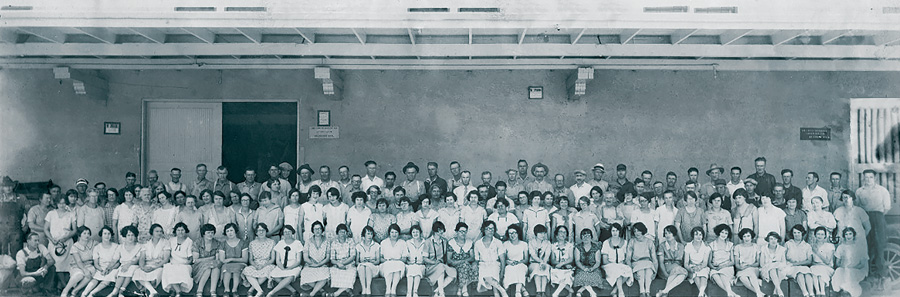
Orange, California. Courtesy of Orange Public Library.
Santiago Orange Growers Packinghouse Interior, c. 1928
In 1929, the Santiago Orange Growers Association was the largest Valencia orange packinghouse in America, shipping over 800,000 crates (or 50 million pounds) a year. At the beginning of World War II, a packinghouse was built at 350 North Cyprus Street for the association. The Villa Park Orchards Association purchased this packinghouse in 1967. It operated through 2005.
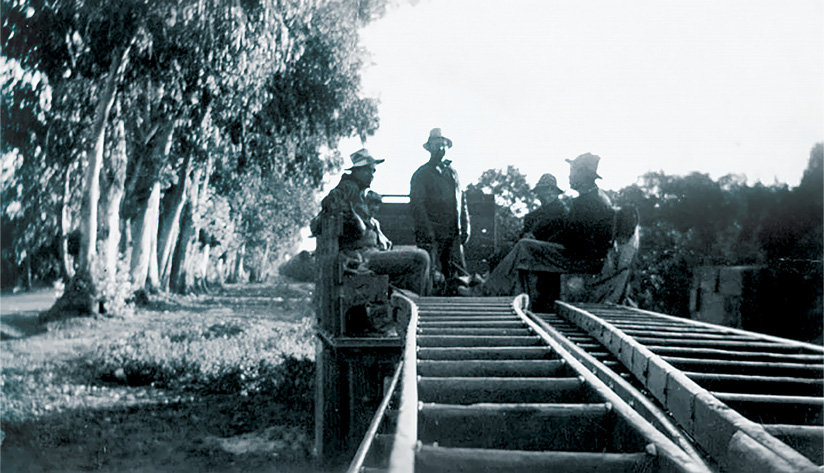
Shades of Orange Cypress Street Barrio Collection. Courtesy of Orange Public Library.
Orange Pickers with Ladders, 1942
Unlike crops that could be harvested by large machines, oranges had to be harvested by hand, which required an enormous number of workers. Pictured here are orange harvesters at rest.
WORLD WAR II COINCIDED WITH A DECLINE IN THE CITRUS INDUSTRY in Orange County. There was a shortage in the cheap labor employers wanted. Many residents of the barrio sought jobs outside of the agricultural industry like construction and manufacturing. Others enlisted in military service.
On August 4, 1942, the US and Mexico signed the Mexican Farm Labor Agreement (today referred to as the Bracero Program). During the program’s 22 years, thousands of Mexican citizens joined the US labor force as temporary agricultural workers. Orange County benefited from the contributions of around 70,000 braceros during this period, especially during the war when labor shortages taxed the county’s economic base. Two bracero camps were even built on North Cypress Street in the 1940s.

Orange, California. Shades of Orange Cypress Street Barrio Collection. Courtesy of Orange Public Library.
Military Diary Form of Julian Gonzales, c. 1946
This military diary belonging to Julian Gonzales of Orange, California offers a brief timeline of the service person’s military history during World War II.
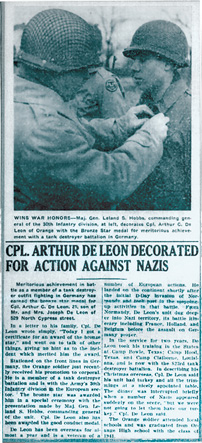
Orange County, California. Shade of Orange Cypress Street Barrio Collection. Courtesy of Orange Public Library.
Clipping on Arthur de Leon, c. 1944
Arthur C. De Leon received the Bronze Star medal in 1944 while serving in the US Army during World War II for a meritorious achievement with a tank destroyer battalion in Germany.